
Credit: Viasat Aug. 5, 2025, investor presentation
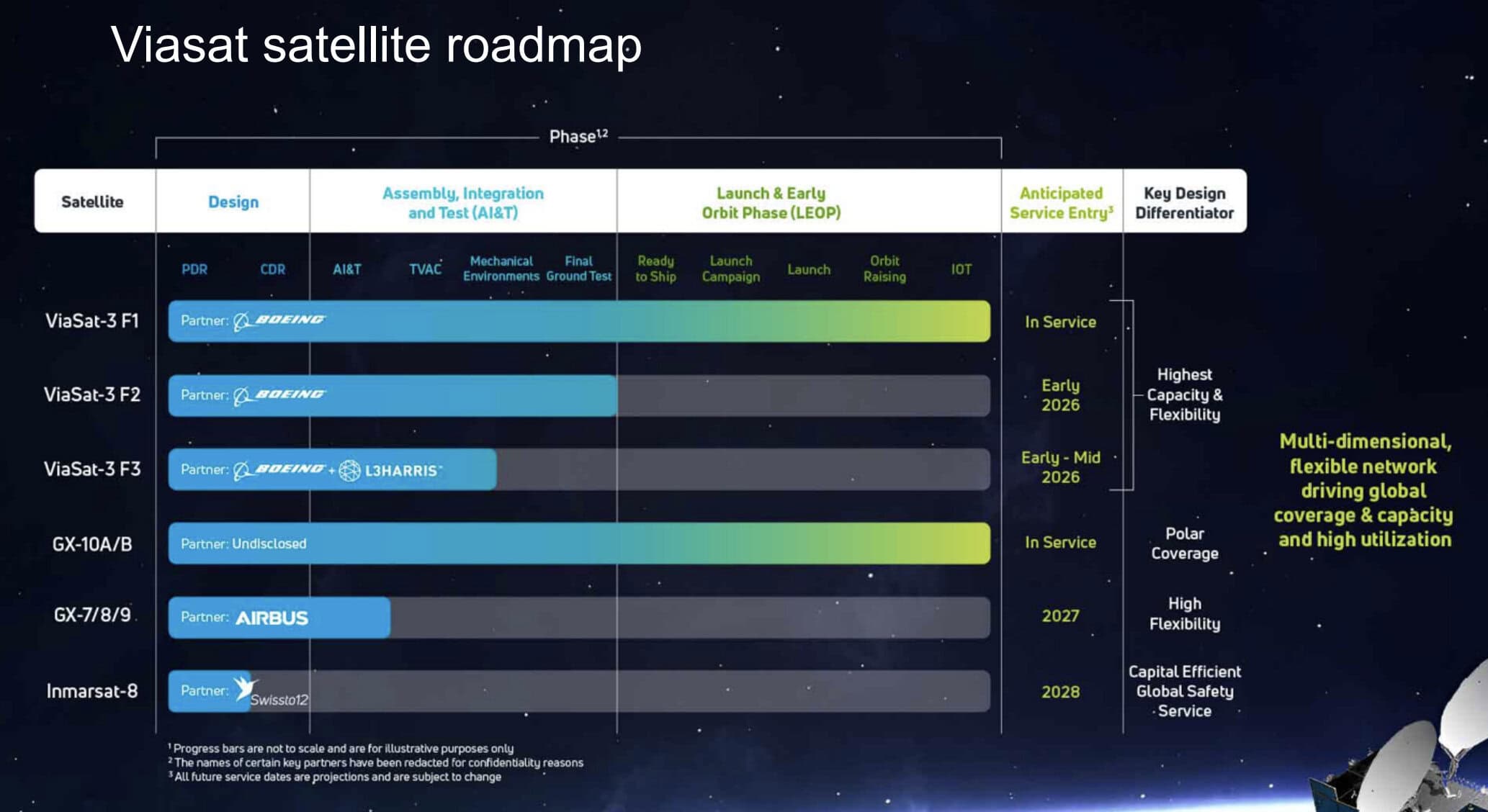
TUPPER LAKE, NY — Satellite hardware and service provider Viasat Inc. has again delayed the launch of its second Viasat-3 1-Tbps-capacity satellite and now expects it will deliver the spacecraft to the launch site in September for a launch lager this year aboard a United Launch Alliance Atlas 5 rocket.
It is expected to be in service by early 2026.
The third Viasat-3 satellite, this one with an L3Harris deployable mesh antenna — the two others have Northrop Grumman antennas — is being readied for mechanical and environmental testing. A firm delivery and launch schedule has not been established, but its service is expected to begin by mid-2026.
In an Aug. 5 investor call, Viasat Chief Executive Mark Dankberg said both satellites’ service start have been adjusted “to account for unknowns in launch and the launch range.”
Dankberg said the Viasat-3 program delays, coupled with the reduced capacity on the first Viasat-3 caused by an antenna deployment anomaly, has accentuated the decline in Viasat’s fixed-broadband division. This is the business that competes for consumer business with SpaceX Starlink as well as Hughes Network Systems.

Credit: Viasat Aug. 5, 2025, investor presentation
Viasat Chief Financial Officer Gary Chase said the company’s said company’s U.S. fixed broadband performance continued to decline, down 33% from a year ago, to 172,000 as of June 30. Average monthly revenue per subscriber held steady at $115.
“U.S. fixed broadband remains pressured until Viasat 3 F2 is in service,” Chase said.
Viasat expects to spend $1.2 billion in capex in the current fiscal year, which ends March 31, 2026, of which $250 million is related to the Viasat-3 program and $400 million to satellites ordered by Inmarsat before Viasat’s acquisition.
The maritime business, like the consumer broadband segment, has suffered from customers’ shift from the Inmarsat-heritage L-band service toward SpaceX Starlink as their primary satcom provider. Viasat maritime service revenue was down 5% in the three months ending June 30 compared to the same period last year, to $117.8 million.
Mobile satellite services provider Iridium Communications is seeing the same effects on its L-band business and is responding by a higher-speed service, bundled with a mandatory Global Maritime Distress and Safety Service, that shipowners can use as a backup.

Credit: Viasat Aug. 5, 2025, investor presentation
Viasat’s solution is its NexusWave, a managed-service offer that combines GEO and LEO satellite capacity, with the LEO piece coming from Eutelsat’s OneWeb constellation.
Introduced in early 2025, Viasat announced it had 1,000 ships under contract as of July 1.
“ARPU per vessel is significantly higher [than the previous L-band service] because we are delivering more bandwidth, for operational applications plus crew services, not just operational as in the past,” Dankberg said. “That’s what is driving the sequential growth in maritime.”
The company reported maritime service revenue of $114 million for the three months ending March 31, 2025, so the June 30 figures represent an increase of 3%.
Viasat is centering much of its Viasat 3 commercial strategy on the aviation market. This business reported $293 million in service revenue for the quarter, up 13.9% from a year ago and in increase in outfitted aircraft to 4,100 commercial planes from 4,000 a year ago; and 2,100 business aviation aircraft compared to 2,000 last year.
Dankberg spent much of the call reiterating his company’s thesis that it’s much more cost effective for operators of L- and S-band mobile satellite spectrum to band together to share their assets, much as mobile telcos share towers.
The investor call came just four days after EchoStar Corp., which like Viasat holds S-band licenses, announced it would spend about $5 billion on a constellation of 200 LEO S-band satellites to provide 5G-equivalent service to unmodified smartphones and other devices anywhere on the planet.

Credit: Viasat Aug. 5, 2025, investor presentation
A top priority for Viasat at the moment is to launch its planned satellites and generate sufficient cash flow to reduce its leverage, which is now 3.6 times the company’s adjusted EBITDA for the past 12 months.
But Dankberg said the company’s decision not to build a large L- or S-band LEO constellation is not because of its debt, but because of the logic of having multiple mobile satellite spectrum license holders combine their resources to the benefit of all.
The benefit, lower capex and opex for the operators, would lower the end-user price of direct-to-device (D2D) satellite connectivity at a time when the automotive, unmanned aerial vehicle and other markets are ready to adopt standards-based satellite links.
“Historically the operators have all looked at each other as arch enemies,” Dankberg said. “Now there is a really good opportunity. Especially as that business becomes more focused on open architecture and 3GPP standards, there doesn’t seem to be a reason that each operator has to have space infrastructure that’s unique to their space segment.
“We have really good technology for building wide-band systems that can serve multiple operators and still be able to do all the beam-forming work that’s needed to get the D2D PFD [power flux-densities] needed on the ground. That’s what we’re working toward. A constellation that doesn’t have high power flux densities on the ground isn’t going to work in the D2D environment, not at the 5G radio functions that people want. That drives interest in a LEO component. But if you want high capacity, it grows linearly with spectrum.
“Our objective is to build the system at substantially lower cost than $5 billion, and to be able to share that infrastructure among multiple operators. We’ve gotten interest from other operators who see the same benefits that we do.”
Key to a project like this would be the participating operators’ trust in the network manager, a role Viasat would like for itself. Dankberg said governance issues of the multi-operator network are still being discussed. “It’s not way off in the future,” he said
“The spectrum holders want to be assured that the infrastructure provider is treating all spectrum holders fairly, that there’s no competitive disadvantage to not owning their own infrastructure.”