

Open Cosmos’s ConnectedCosmos constellation will deploy software-defined satellites into a 1,050-km orbit for broadband connectivity. Credit: Open Cosmos
LA PLATA, Maryland — Satellite manufacturer and startup broadband constellation operator Open Cosmos in the coming weeks will get answers to two questions that are key to its near-term future:
Can it raise $200 million to finance its Ka-band broadband constellation in time to build and launch sufficient satellites by its June and September deadlines while sticking to its policy of relying only on European funding?
If the answer is yes, the second question is: Will the company be able to persuade its regulator, Liechtenstein’s Office of Communications (AK), to extend the deadlines?
Even if it raises the needed capital, the global launch market is in a condition of sharp undersupply. If launch capacity is the main reason Amazon Leo is sweating its deployment deadline, despite all its resources, imagine the situation for Open Cosmos.
In a May 26 presentation at EU Space Days, organized in Nicosia as part of Cyprus’s presidency of the European Union, Open Cosmos sounded confident.

Maria Kalama. Credit: EU Space Days video
“We will raise funds when as as we needed it,” said Maria Kalama, managing director of Open Cosmos Aegean, based in Greece. “We only do European funds. It’s important to be a European-funded company.
“These are very good times. The [European] VC and investment market is capital-efficient. It does invest money. In Greece we have VC funds that do everything from angle to what we call institutional investors. Are we at the level of the US? I would say no.”
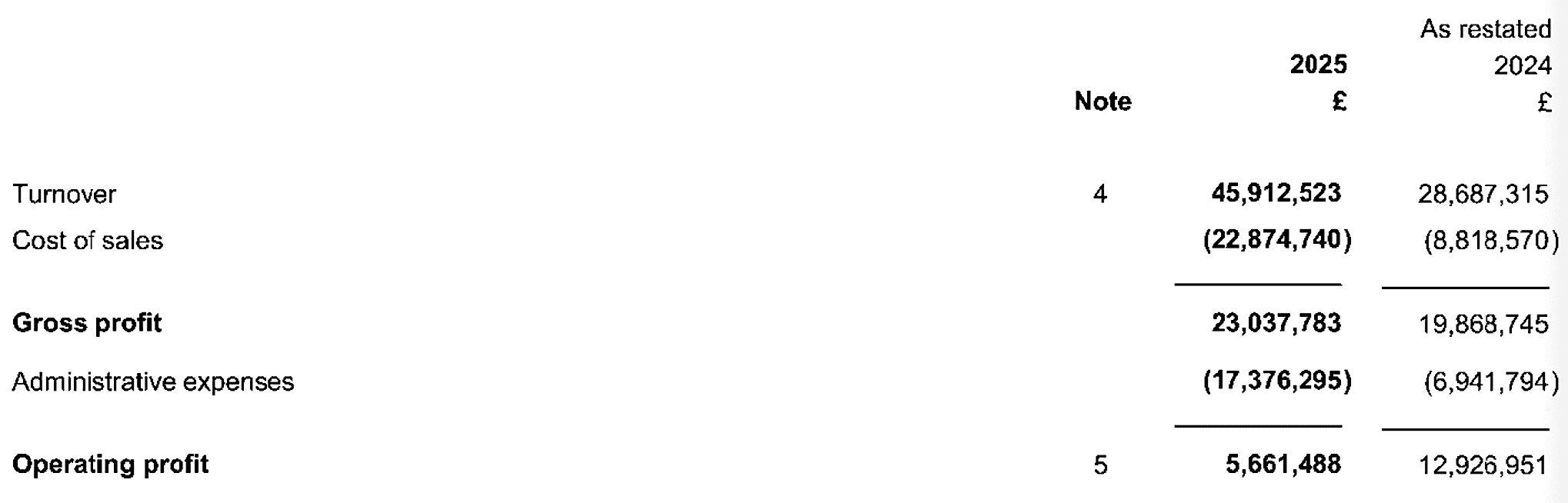
Figures are in British pounds Credit: Open Cosmos.
Open Cosmos reported 2025 revenue of 45.9 million British pounds ($61.9 million), up 60% from 2024. But operating cash flow, at 3.9 million pounds, was down 87% from a year earlier as administrative and other costs more than doubled during the year. Operating profit at 5.7 million pounds, was down 56%.
R&D investment was up 57% as the company continued investing in product, especially its broadband constellation. Headcount for the group, at 164 full-time employees was up from 107 a year ago.
“A pivotal component of our forward-looking strategy includes ConnectedCosmos, a constellation of satellites to provide connectivity services and real-time insights of Earth,” the company said in its 2025 financial report, filed May 21.

Credit: Open Cosmos 2025 financial report

Cash on hand at Dec. 31, 2025, was 66.1 million pounds, including a 27-million-pound convertible loan and 22 million pounds of venture debt. The venture debt total is 50 million pounds, with the remaining amount to be received this year.

The OpenConstellation merges backing from several European governments to build a “mutualized” constellation for geospatial intelligence. Credit: Open Cosmos
Open Cosmos’s current business model is to encourage investment from European governments by promising to build satellites on their national territory.
The company now has installations in Britain, Spain, Greece, Portugal, Liechtenstein, the United Arab Emirates, Japan and Argentina. It is building a constellation of geospatial imaging satellites for Spain, Portugal and Britain.
“We build everything from the ground up in a country,” Kalama said. “We find a lot of good skills in Greece thanks to EU and ESA [European Space Agency] programs.
“We have had to up-skill quite a few people and transfer technology on, for example, how the cells are placed on the solar panel. We had to invest and we do this in any geography we operate in. We are flexible and risky enough to go to a new territory, set up and deliver.”

Revenue by program. Credit: Open Cosmos 2025 annual report
The company has clearly positioned itself as a European asset, not a UK or Greek or Spanish builder.
“We have been successful in procuring an important asset for Europe: high-priority Ka-band spectrum rights, and we are launching a connectivity constellation.”
Open Cosmos’s satellites have software-defined payloads, offering flexibility that may allow it to establish a business without needing hundreds of satellites.
Its OpenConstellation is in fact two satellite networks filed at the International Telecommunication Union (ITU) by Liechtenstein’s regulator. The company’s chief executive, Rafel Jordà Siquier, said the effect of that is to give each satellite the ability to register four space stations to the ITU.
In a March interview, Siquier said the company’s production sites in Britain, Spain, Portugal and Greece were working 24/7 to produce satellites and could produce 100 satellites a year.
The current ITU deadline is that Open Cosmos must launch 50% of its constellations by June 10 and September 28. However many satellites it has in service by then will be considered 50% of its total authorized network. The remaining 50% must be launched two years later.